
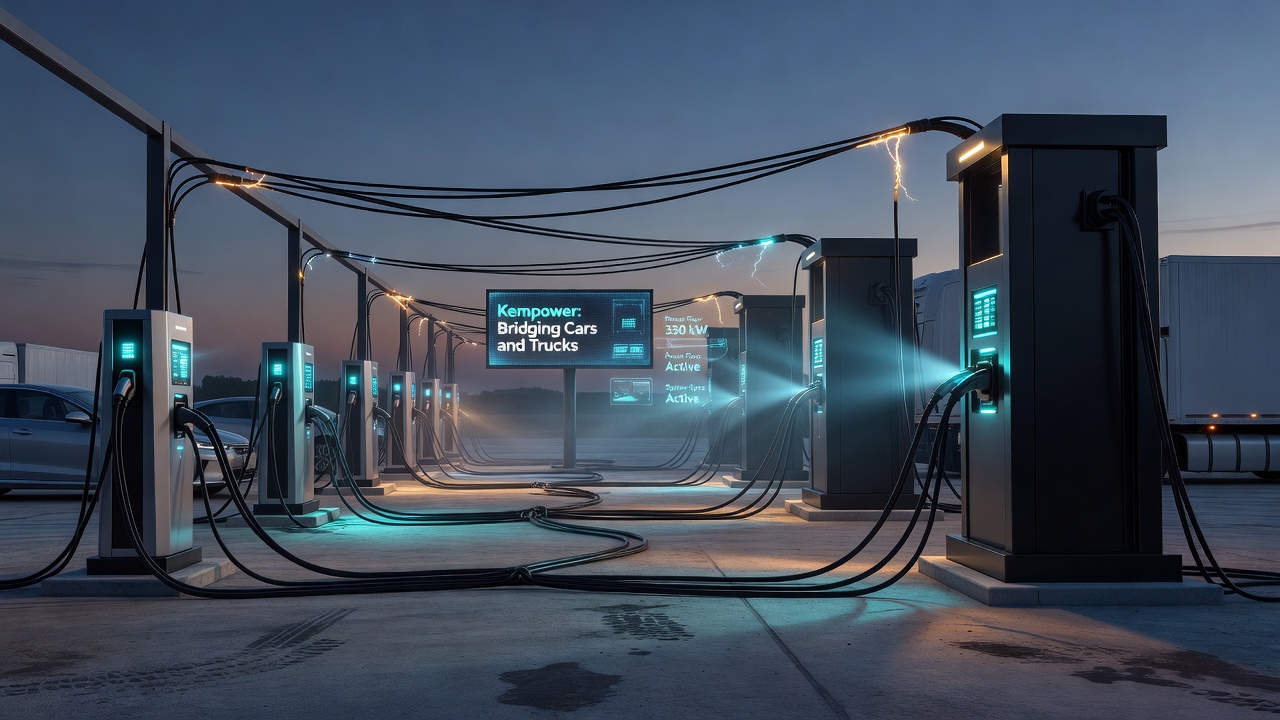
A single charging dispenser that can fuel a passenger sedan and a heavy-duty truck without separate infrastructure is no longer a concept on a slide deck. Kempower has unveiled the Mega Satellite Flex, a high-power charger capable of delivering up to 560 kW through the established CCS standard or up to 1.2 MW through the newer Megawatt Charging System, aimed squarely at the widening gap between passenger EV charging and the far more demanding needs of electric trucks.
The announcement lands at a genuinely awkward moment for the charging industry, one defined less by consensus than by a slow, expensive transition. CCS remains the default for cars and light commercial vehicles across North America and Europe, while MCS is still being built out as the standard for trucks and other heavy equipment that require power levels ordinary chargers cannot approach. Site operators have been forced to choose, essentially betting on which standard will dominate a given location, or paying twice to cover both. That kind of uncertainty already shapes decisions well beyond hardware; even consumers comparing privacy tools or providers such as providers such as BuyBestVPN face similar trade-offs between committing early and waiting for a market to settle, and charging infrastructure investors are no different.
What makes the Mega Satellite Flex notable is not the raw power figures alone, though 1,500 amps on the MCS side and 700 amps for CCS are substantial, but the fact that both live in one unit. Operators can install a single dispenser and serve whichever vehicle pulls up, whether that's an 800-volt passenger EV taking advantage of faster charging or a long-haul truck that needs a megawatt-class connection to stay on schedule. The unit also supports a payment terminal directly, which matters for public sites trying to serve a broad customer base without extra hardware.
Why One Dispenser for Two Standards Matters
Building charging infrastructure is capital-intensive, and idle equipment is the enemy of return on investment. A site designed only for passenger cars sits underused if truck traffic grows nearby, and a site built exclusively for MCS wastes its potential during the years before heavy-duty electric trucks reach meaningful numbers on the road. By supporting both standards from a single cabinet, Kempower is effectively hedging against an uncertain adoption curve, letting operators capture utilization from cars today while positioning for trucks tomorrow. That flexibility is likely to matter more than any individual power figure, because uncertainty about the transition timeline has been one of the biggest reasons investment in heavy-duty charging corridors has lagged behind demand.
Fitting Into Existing Charging Networks
The Mega Satellite Flex is built to work with Kempower's existing distributed charging architecture, meaning operators who already run Kempower systems can add the new dispenser without redesigning their sites from scratch. The cable lengths, 5 meters for CCS and 2.7 meters for MCS, reflect practical realities: passenger vehicles and trucks park differently, and connectors need to reach ports that sit in very different positions on each vehicle type. Kempower revealed the charger at its Unplug & Recharge event held alongside ACT Expo, where it remains on display this week, with commercial availability in North America and Europe expected in July 2026. That timeline gives fleet operators and charging network builders more than a year to plan sites around a single piece of equipment rather than two, a small but meaningful simplification in an industry still working out how fast the shift to electric trucking will actually happen.